About the barometer ⏲
The development of the housing barometer has been carried out on the basis of seven components, which are summarized in the following table:
| Component |
Name component (*) |
Source variable (*) |
| Price pressure | Price_risk | Real_price |
| Sales flow | Sales_risk | Home_sales |
| Mortgage approvals | Mortgage_risk | Approved |
| Wage effort | Wage_risk | Dif_Wage_IPVVR |
| House scarcity | Scarcity_risk | Balance_hogares |
| Building profits | Production_risk | Ratio_price_cost |
| Unemployment risk | Labor_risk | Unemployment_yoy_per |
(*) The names refer to the title they have in the database.
Price pressure
The price pressure is obtained by applying the following formula:
}{\max(x_{range})-\min(x_{range})}\times100)
Where:
- xn, is the reference value for the desired year from Real_price
- xrange, represents the values that are part of the range of the last 15 years (including the reference year)
- min, is the minimum value among the existing values in the range xrange
- max, is the maximum value among the existing values in the range xrange
Sales flow
The sales flow is obtained by applying the following formula:
=\frac{x_{n}-LI_{n}}{LS_{n}-LI_{n}}\times100)
Where:
- xn, is the reference value for the desired year from Home_sales
- LIn, is the reference value for the desired year from Lower_limit
- LSn, is the reference value for the desired year from Upper_limit
- min=0, means that if the returned value is less than 0, it is represented as 0
- max=100, means that if the returned value is greater than 100, it is represented as 100
Mortgage approvals
The mortgage approvals is obtained by applying the following formula:
=\frac{x_{n}-LI_{n}}{LS_{n}-LI_{n}}\times100)
Where:
- xn, is the reference value for the desired year from Approved
- LIn, is the reference value for the desired year from Lower_limit
- LSn, is the reference value for the desired year from Upper_limit
- min=0, means that if the returned value is less than 0, it is represented as 0
- max=100, means that if the returned value is greater than 100, it is represented as 100
Wage effort
The wage effort is obtained by applying the following formula:
}{\max(x_{range})-\min(x_{range})}\times100)
Where:
- xn, is the reference value for the desired year from Dif_Wage_IPVVR
- xrange, represents the values that are part of the reference range (all available)
- min, is the minimum value among the existing values in the range xrange
- max, is the maximum value among the existing values in the range xrange
House scarcity
The house scarcity is obtained by applying the following formula:
}{\max(x_{range})-\min(x_{range})}\times100))
Where:
- xn, is the reference value for the desired year from Balance_hogares
- xrange, represents the values that are part of the range of the last 30 years (including the reference year)
- min, is the minimum value among the existing values in the range xrange
- max, is the minimum value among the existing values in the range xrange
Building profits
The building profits is obtained by applying the following formula:
=\frac{x_{n}-1.8}{2.2-1.8}\times100)
Where:
- xn, is the reference value for the desired year from Ratio_price_cost
- 1.8, represents the minimum value defined as a constant
- 2.2, represents the maximum value defined as a constant
- min=0, means that if the returned value is less than 0, it is represented as 0
- max=100, means that if the returned value is greater than 100, it is represented as 100
Unemployment risk
The unemployment risk is obtained by applying the following formula:
%20%3D%20%28A%20-%20X_%7Bn%7D%29%2BB.svg)
Where:
- xn, is the reference value for the desired year from Unemployment_yoy_per
- min=0, means that if the returned value is less than 0, it is represented as 0
- max=100, means that if the returned value is greater than 100, it is represented as 100
- A and B they represent values that correspond to conditionals


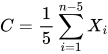
Where:
- A captures the speed of unemployment, whether the rate is stagnant, rising, or falling
- B captures the change in trend, whether unemployment shifts from rising to falling, or vice versa
- C is the average unemployment rate over the last 5 years
- xn-1 represents the value of the year prior to the reference year of the variable Unemployment_yoy_per
- xn-2 represents the value two years prior to the reference year of the variable Unemployment_yoy_per
Notes
For the mathematical notations, the Latex Math API developed by @uechz has been used.


